‘Nevertheless, life is pleasant, life is tolerable. Tuesday follows Monday; then comes Wednesday. The mind grows rings; the identity becomes robust; pain is absorbed in growth. Opening and shutting, shutting and opening, with increasing hum and sturdiness, the haste and fever of youth are drawn into service until the whole being seems to expand in and out like the mainspring of a clock. How fast the stream flows from January to December! We are swept on by the torrent of things grown so familiar that they cast no shadow. We float, we float…’
Virginia Woolf – The Waves
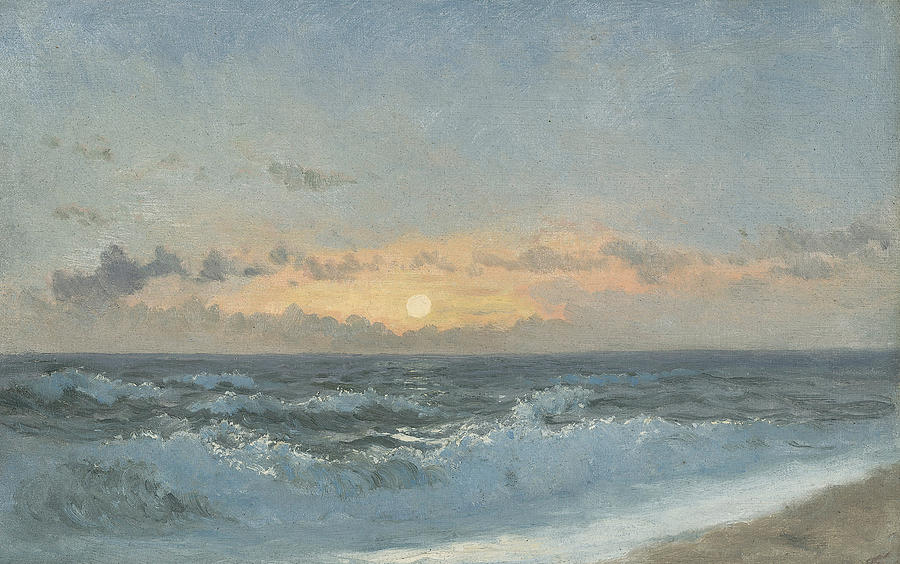
William Pye – Sunset over the Sea
There is a strange sense of security and stability in the cadenced movement of the sea. Smooth and supple creases fold and mount into a heaving and rippling crest of temptation, falling with languorous sighs at one’s feet in a translucent fan. There is a strange sense of security and stability in rhythm, in repeated, coherent affirmation of a logical cycle, suggesting the convenience of predictability upon which all nature works and cooperates. The ebb and flow, sunrise and sunset, the seasons, the delicate thread of human existence.
In a metaphorical span of a single day, Virginia Woolf neatly portrays the lives of six friends in a quicksilver flow of swiftly changing internal monologues, following their journey from childhood into old age, and eventually death. Fusing and melting into each other like the sky and the sea on the far horizon, their struggles and victories become an intimate reflection of the world they courageously challenge with their respective perceptions; a reflection so intimate that its nakedness and vulnerability, sincerity and passion mould into a poetry of a distinct kind, a magnificent fleuve of dazzling visions seen as if through a kaleidoscope, always fresh, always bright, titillating the mind with the possibility of an almost endless interpretation.
And all the while the waves are beating upon the shore with rhythmic patience, leaving sparse traces of gleam upon the misty sand as though in a farewell gesture.
‘It makes no sign, it does not beckon, it does not see us. Behind it roars the sea. It is beyond our reach. Yet there I venture. There I go to replenish my emptiness, to stretch my nights and fill them fuller and fuller with dreams.’
Virginia Woolf – The Waves
One ripple chases another in a steady pattern. Was there sorrow before joy, or joy before sorrow? Is it life drawing its first breath with the cry of an infant, or is it death staring at it from a mirror? Was love born of pain so insurmountable that it could not but expand and evolve into a force still greater, or is love the mother of suffering? They spin around in a dizzying dance of light and shadow as in a ceremony of courting, a play of mirrored reflections gazing at each other with their eyes wide open, longing to touch through the invisible barrier of their inherent difference. What a blessing to have them so entwined, what a miracle that they always come with their spears united to pierce the chest, what a delight to become so attuned to the nuances of pain that life ceases to be merely a chain of haphazard external sensations, and suddenly becomes an internal truth, a tangible mass of hardened facets of love. A life well lived is life subdued, exposed to the reality of fear and ecstasy, a hard stone upon which rivulets of tears engraved their pathways.
‘There can be no doubt, I thought, pushing aside the newspaper, that our mean lives, unsightly as they are, put on splendour and have meaning only under the eyes of love.’
Virginia Woolf – The Waves
A life well lived is a life perceived fully, accepted unconditionally in all its staggering variety, so that, finding oneself at the end of all crossroads, looking back one hears himself say – yes, I, too, have been there.
« La dernière chose – celle dont l’art est fait – se passe dans la salle de concert. »
Krystian Zimerman
One of the most famous lines of Saint-Exupéry’s little masterpiece of reflection Le Petit Prince says that what is essential is invisible to the eye, for it is only with the heart that one can see rightly. Eyes – the window to one’s soul, the extraordinary chain of mechanisms of light and refraction that enables us to behold the beauty of the world. And yet there is still so much they cannot touch, cannot reveal. Experience would confirm to any of us at a certain point in our lives that very often there is a long distance to be covered between the eye and the heart, when the true meaning of shapes and luminescence becomes lost on us unless a higher organ of perception is called to help.
On
Friday evening, 7th June, I wondered, while seated in the spacious,
floating lagoon that is the Paris Philharmonic, that if there is truly so much
the eyes cannot see, then, possibly, how much is there the words cannot tell?
A handsome
gentleman walked onto the podium that moment, his silvery hair as resplendent
as the touch of his hands on the ivory keys of the grand piano, his graceful poise
so controlled and yet so emotionally eloquent that it made all the words in the
world meaningless and superfluous, for in those two hours everything was said,
though no verbal communication was transmitted between the sold-out hall and
the artist.
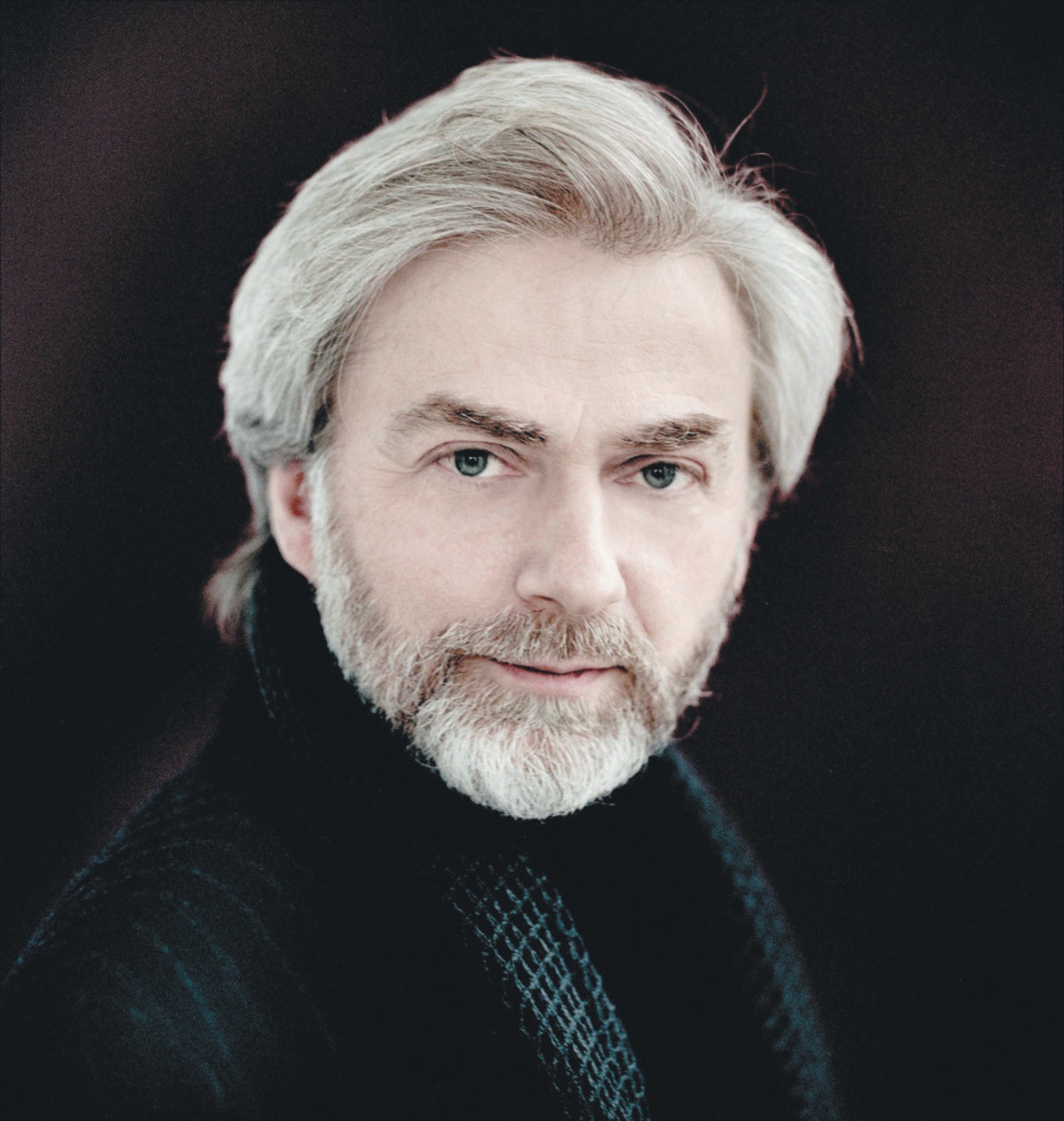
There are undoubtedly few delights this world can offer quite like the musical artistry of Krystian Zimerman – the living legend of pianism. The clarity of his tone, the fineness of his touch, the acute presence and mastery of emotional balance rendering his performance the peak of artistic splendour makes for an unforgettable experience with the divine language of music. A powerful stage presence made itself felt the moment his hands touched the keys without much reticence, and the opening motive of Brahms’s Piano Sonata no. 3 in F minor spurted from beneath his fingers in an impetuous, majestic cry accentuated by a heavy descent of the bass line.
As it is the custom with Brahms, strong currents of lurid passion are interlaced with heart-piercing tenderness where lilting motives of lyrical beauty are set off by sturdy maladroitness of the contrasting, heavy themes. Sonata in F minor is definitely a mysterious, complex piece that is very hard to grasp and leaves much to ponder. Even a trained listener has to tune his alertness to the finest levels of perception to be able to unveil all the themes and counterthemes that evolve, repeat and overlap throughout the long piece, and thus to get an accurate glimpse of the composer’s fiery intelligence.
Beginning with a furious Allegro maestoso, the sonata proceeds from a place of tragic insistence to an oasis of poetic reflection of the Andante movement only to dash into a tricky Scherzo that feels more like a sinister grin than an innocent joke. The whole piece is completed by pensive, subdued and somewhat funebrial Intermezzo with subtle hints at the famous main motive of Beethoven’s 5th symphony scattered all over the place. The listener is then led to a vigorous Finale through which rays of warmth shine every now and then thanks to motives in major keys, and the triumphant, virtuosic ending leaves an aftertaste of victory, effectively erasing all the gloom and heaviness of the previous struggles.
In Krystian Zimerman’s hands, this complicated, almost 40 minutes long piece of music transformed into a stream of liquid silver as he with breathtaking command steered this exhaustive search of self into a place of transcendence and beauty where one is strictly confronted with both the darkness and light of existence, and where these marked contrasts no longer fight for predominance, but rather live in perfect harmony, complementing each other by mutually highlighting their most splendid features.
The following program consisting of Four Mazurkas op. 24 and four Scherzos by Frédéric Chopin was like a breeze of fresh air flowing through a sunlit garden in full bloom. The art of melodic ingeniousness supported by steady harmonic development of these heart-warming pieces (a trait so pronounced and everpresent in Chopin’s compositions) was delivered with both joy and ease, and as each of the Scherzos was followed by a thunderous applause, that enigmatic je ne sais quoi that exists only during those ephemeral moments of music making was suddenly overwhelmingly tangible and palpable.
As I was leaving the large hall with the roar of approval and appreciation from the audience still ringing in my ears and the dazzling, thankful and humble smile of the artist firmly fixed within my heart, that moment I knew that during those two hours of a dream come true and pure aesthetic bliss – for the eyes as for the ears – I had had the privilege to be a part of a one-of-a-kind performance, a witness of a great life experience and deep feeling transmuted into music where each timbre of sound delivered a nostalgic rush of emotion, inviting the listener to share that moment of perfect vulnerability with the artist, and challeging him to do the most daunting task one can possibly imagine – to let go of walls, let go of denfenses, and feel the naked intimacy of being confronted with the secrets of one’s heart.
« Je m’appelle Marc, j’ai l’intestin très sensible et pas d’argent, mais on dit que j’ai du talent. »
Marc Chagall – Ma vie
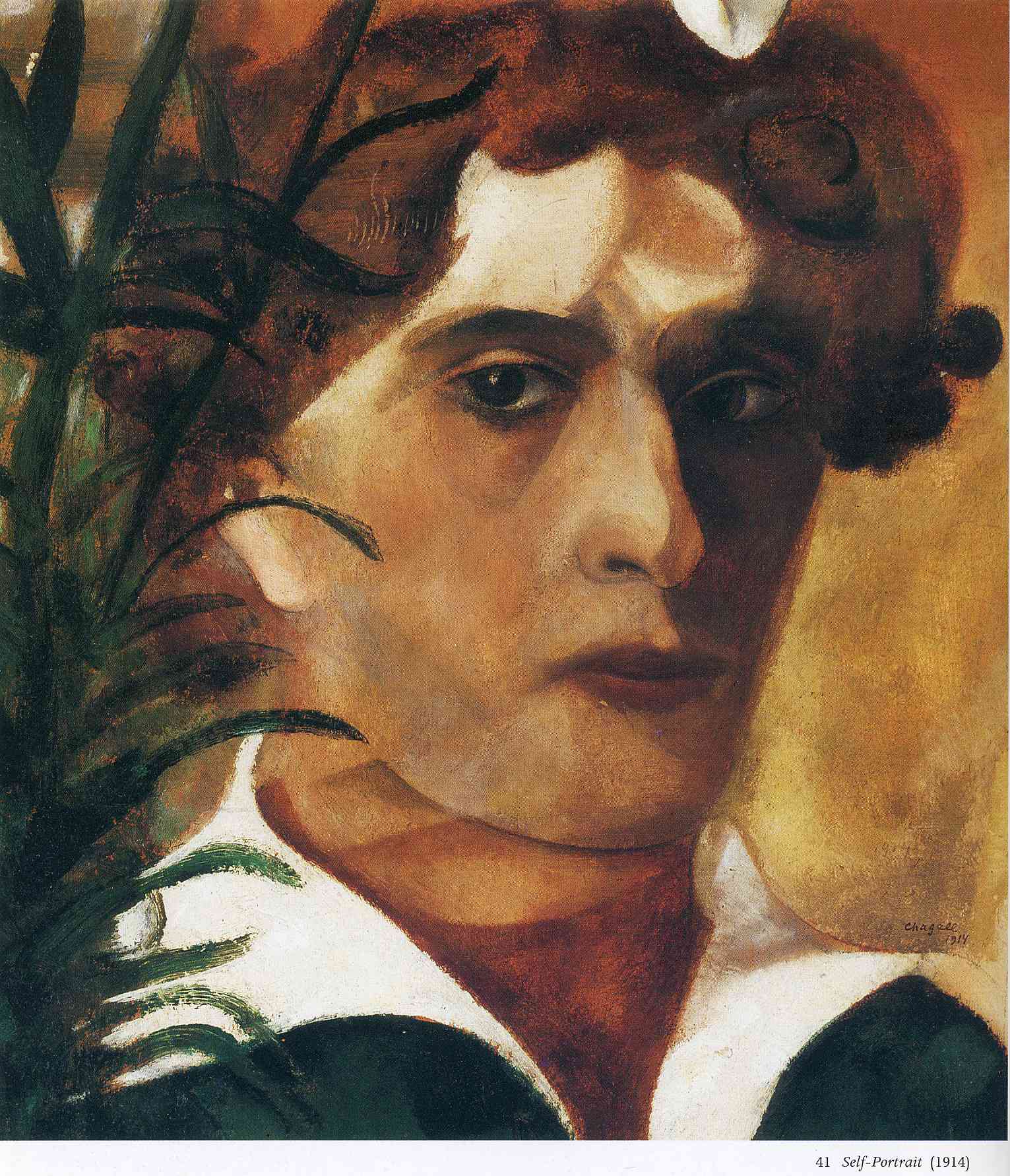
Autoportrait au col blanc, 1914
Numerous attributes come to my mind each time my eyes brush against a canvas bearing the indelible Chagall signature, the most prominent of which would certainly be tenderness, and reverie. The timeless charm, a certain childlike naïveté of his depictions combined with the iridescent hue of colours make for a unique experience that touches the soul. Above all that, there is also an element of incomparable seduction and invitation in Chagall, encouraging one in a very intimate engagement with his work through its astounding richness of meaning that offers a plenitude of interpretation. As in a dream one is transported into a world where each colour has its own definite implication and context, where mere shapes tell their own stories, where cultural influence espouses deeper spiritual significance.
Born in 1887 in Vitebsk, the firstborn of nine children, Chagall’s life, like his work, gives the impression of a pilgrim in a constant movement between worlds and between cities, rising from humble origin into a wealthy milieu, traveling the world and yet longing for the warm place of simplicity and familiarity that is so strikingly evident mainly in his touching depiction of village life where family, religion, nature and music are closely interconnected. A child of a devoted Jewish family, his decision to embark on an artist’s path was definitely not without obstacles, but a steady flow of artistic output that followed his starting point at the studio of Yehuda Penn in 1906 shows a man wholeheartedly devoted to a vocation that he with the same characteristic charm reflected also in his paintings made entirely his own.
« Muni de mes vingt-sept roubles, les seuls que j’aie reçus de mon père, dans ma vie (pour mon enseignement artistique), je m’enfuis, toujours rose et frisé, à Petersbourg, suivi de mon camarade. C’était décidé. »
Marc Chagall – Ma Vie
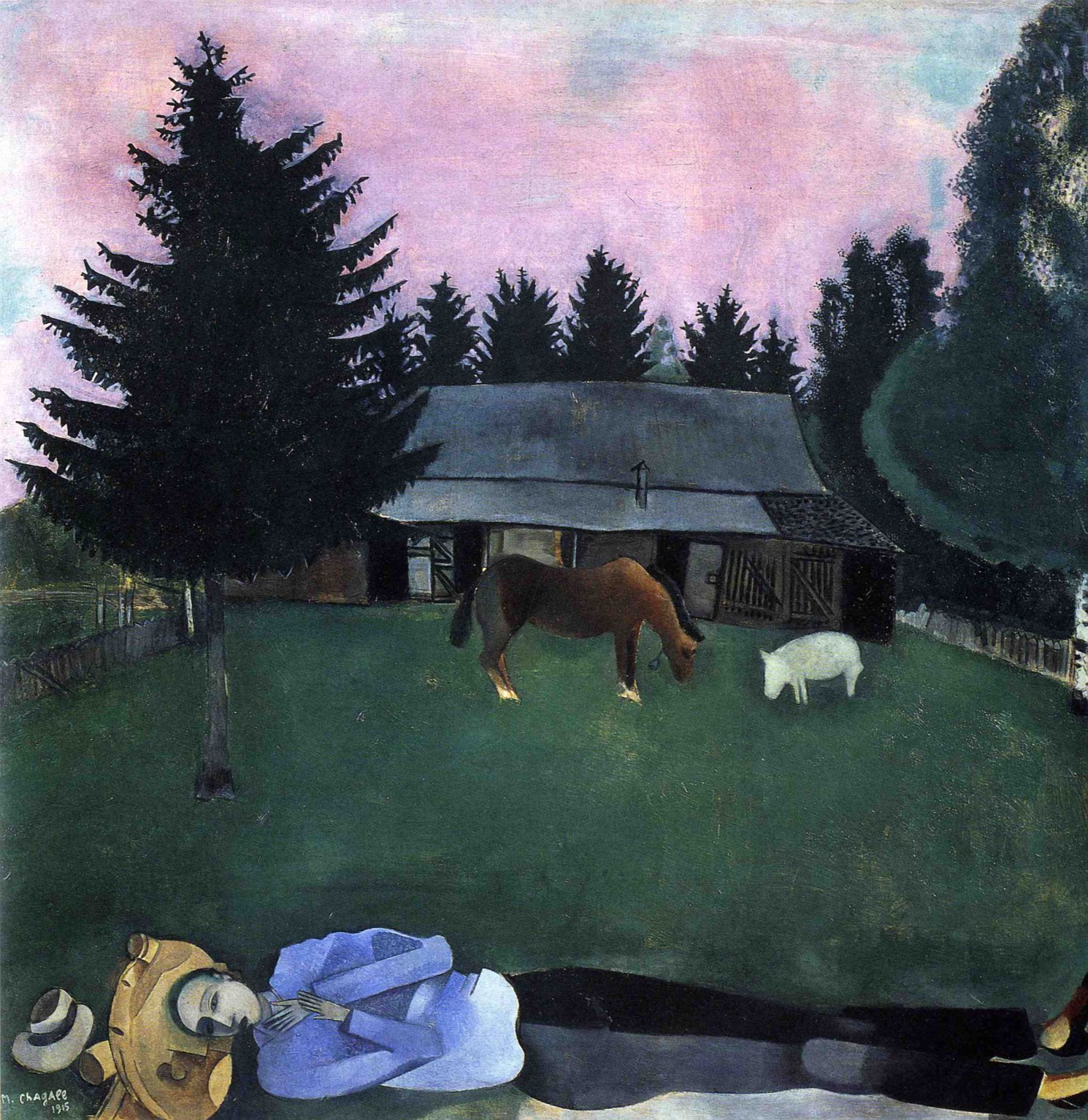
Le Poète allongé, 1915
As I was able to follow Chagall’s life through his artwork thanks to a beautifully arranged biography of the Taschen painters edition, I felt as though I were entering a world where even time itself pauses to take a deep breath in its wild race towards eternity, where the only thing that matters is to watch with eyes and heart wide open to fully perceive the beauty, the depth of the moment captured with both intensity and gentleness that the painter offers, as if he were giving each of his paintings a life of its own. One of the most suggestive examples of this realm of peaceful quiet and halted time I found in the Le Poète allongé, whose relatively restrained and subdued hues endow the scenery with an air of fragility and profound calmness spreading like a blanket over the poet’s dream, and the painting seems as though knitted from the melody of the famous Schumann Träumerei. I don’t think it would be very far from truth to say that one almost feels invited into the poet’s dream, a dream that remains thus locked in one’s imagination yet becomes an integral part of the whole experience this painting evokes.
« J’ouvrais seulement la fenêtre de ma chambre et l’air bleu, l’amour et les fleurs pénétraient avec elle. Toute vêtue de blanc ou tout en noir, elle survole depuis longtemps à travers mes toiles, guidant mon art. »
Marc Chagall – Ma vie
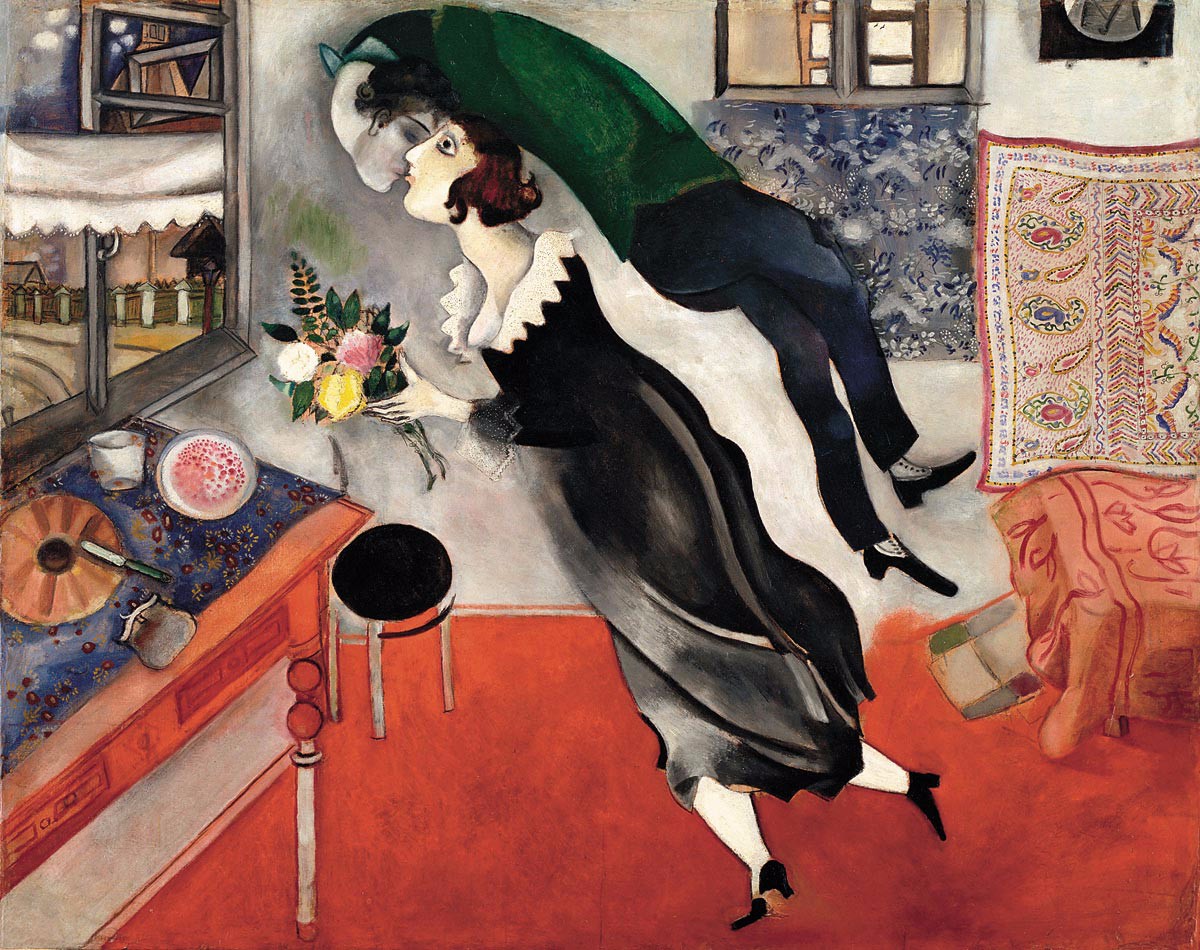
L’Anniversaire, 1915
Another theme pervading Chagall’s work like the scent of cherry blossoms is the one inspired by his great love for his fiancée and later his first spouse Bella Rosenfeld, the daughter of a wealthy jeweler, whom he married in 1915 – an event resulting in L’Anniversaire, a deeply touching testimony to the purity of the couple’s love where the tenderly kissing pair, the cozy room evoking the glow of a newfound happiness, the village behind the window and the little bouquet in Bella’s hands make one the privileged witness of a very personal moment. Accordingly, an apt choice of colours accompanies this scene of marital bliss where the bolder tones of red emanating warmth are finely balanced with the cooling shades of black, grey, white and blue. What fascinates me particularly about this painting is the great emphasis on an exquisite work of detail like that of the embroidered tapestry in the background, and the table with objects of daily usage, bringing to the picture also the pleasurable, earthy presence of the quotidian as a pillar of solidity amidst this fluttering, amorous dream.
« L’essentiel, c’est l’art, la peinture, une peinture différente de celle que tout le monde fait. Mais laquelle ? Dieu, ou je ne sais plus qui, me donnera-t-il la force de pouvoir souffler dans mes toiles mon soupir, soupir de la prière et de la tristesse, la prière du salut, de la renaissance ? »
Marc Chagall – Ma vie
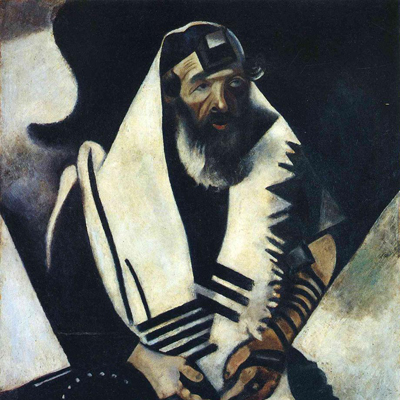
Le Juif en prière, 1914
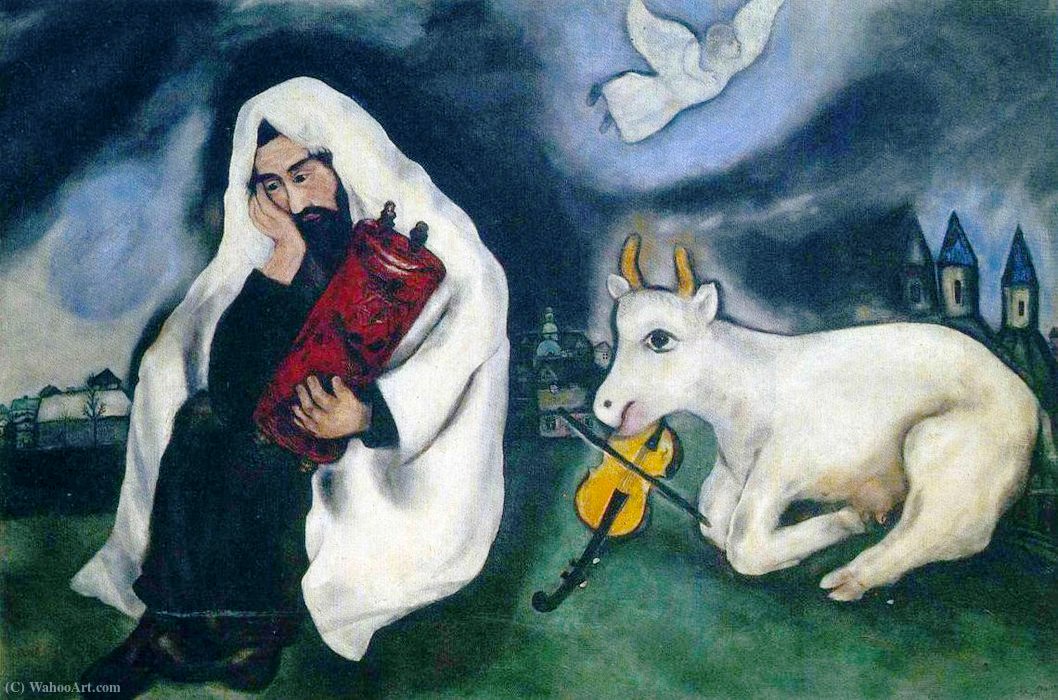
Solitude, 1933
The third major object of the painter’s brush is not merely a religion clothed in Chagall’s unique perception of colour and concept; the spiritual dimension which the painter so generously bestows upon majority of his artworks with Judeo-Christian motives entails also all the tragedy, loneliness and suffering stemming from a deep devotion to the word of God which many a spiritual person encounters in life. In his paintings, the reality of suffering being inseparable from a life of faith comes in repeated patterns, as though the very history of the Israelites and their tribulations across the centuries were the core of Chagall’s principal inspiration. Just like in Le Juif en prière, his painting of a solitary Jew in Solitude holding a roll of Torah firmly in his hands while absorbed in pensive melancholy reveals much of the pain of those loyal to their ethnoreligious background, and also grimly and eerily foretells all the terrors to come during the Second World War.
« Mais mon art, pensais-je, est peut-être un art insensé, un mercure flamboyant, une âme bleue, jaillissant sur mes toiles. »
Marc Chagall – Ma vie
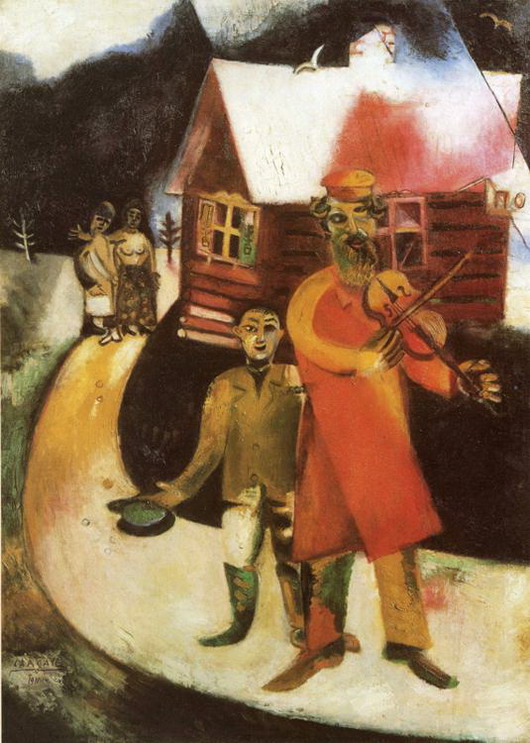
Le Violoniste, 1911 – 1914
Chagall’s pallette is not only bursting with a whole array of tonal progression, making one highly susceptible to each slight shift of mood in his paintings, but it also offers a unique walk down the memory lane into the innocent days of childhood where the simple joys of everyday existence were a pretext enough for merry celebration, like in Le Violoniste where an old musician with a young beggar boy by his side share the extatic moment of a freshly married couple standing timidly in the background, as though abashed by the very magnitude of their own happiness – not merely a depiction of a Jewish wedding, but also a passionate celebration of life in its unstoppable cycle of constant rebirth, the rebirth of love and hope, underlined by the choice of earthy tones evoking the certitude of repetition.
As it is the case with all great artists, Chagall’s work and life are united in an intimate relationship where the one mirrors the other with much ebullience, sensitivity and deep reflection to a degree when it is no longer possible to retell the painter’s biography without a careful and attentive study of his magnificent, multi-faceted paintings full of playful hints and allusions, chromatic gradation and deep love above all; love towards the world with all its sorrows and towards art itself, for it is art that serves as a saving rope which connects the world of emotion with the world of reality and helps to sustain the latter by expressing, expanding and nurturing, with loving care, the former.
One’s life, viewed as a whole, is always the answer to the most important questions. Along the way, does it matter what one says, what words and principles one chooses to justify oneself? At the very end, one’s answers to the questions the world has posed with such relentlessness are to be found in the facts of one’s life.
Sándor Márai – Embers
The moment a bond is formed, a fragment of one’s self inevitably needs to surrender and die; the fragment of one’s self that makes it such an excruciating experience when the most elusive of realities – the bond of souls – is obliterated, thrown across the threshold into the past.
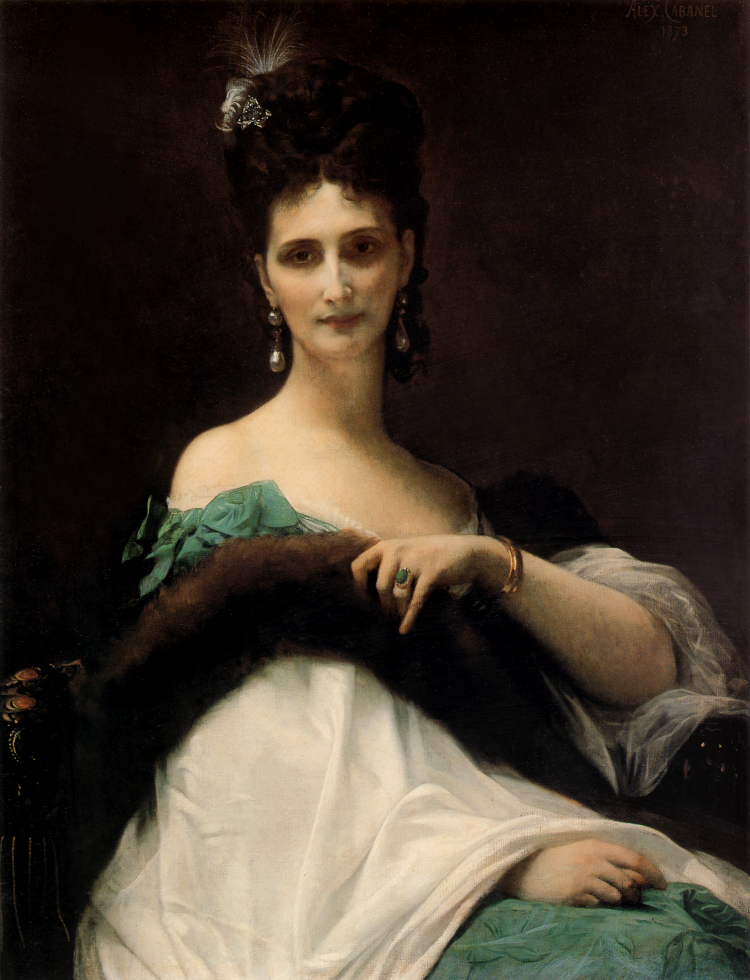
Alexandre Cabanel – La comtesse de Keller
In a castle at the foot of the Carpathian Mountains, an old General awaits a guest, once a lifelong friend, whom he has not seen for forty-one years. Almost as if following the threads on a faded tapestry, their long conversation spanning a single night, resembling a tense and tiring duel of words and silences, will gradually weave the story of a past so softly veiled in mysteries like the morning mists gathering about the forests of the castle. Three silhouettes emerge from their depths, and three lives, bound by love, friendship and fate, find themselves once again, with the benefit of hindsight, coming to crossroads that will with the very same precision divide them forever.
He stood motionless at the window, arms crossed over his chest, looking out at the landscape, the valley, the forest, the yellow road far below, the distant outline of the town. His farsighted eyes picked up the movement of a steadily advancing carriage. His guest was en route. Face expressionless, body motionless, he followed the rapidly moving target. Then he closed one eye as a hunter does when taking aim.
Sándor Márai – Embers
Reading the slender masterwork of the prolific Hungarian writer Sándor Márai almost in one sitting on the eve of my state exam from internal medicine (which, admittedly, was not a very good idea), I realized it had been a very long time since I had had the exquisite pleasure of being so very taken by a book that I would simply forget how quickly time passes by; Sándor Márai’s deftly crafted plot and the splendour of his storytelling prowess left me hanging on his silently moving lips. Embers is not simply a jewel of lush writing and spell-binding atmosphere, it is also a novel of profound psychological insight where the subtle nuances of friendship, love, hatred, jealousy and envy bring to life a chain of powerful, poetic observations, creating a story of memorable impact. Where precisely does the delicate line separating love from hatred lie, the line beyond which trust is broken forever?
And all the others, with flowers in their hair, circling past in a dance, scattering blossoms, notes, ribbons, and long gloves in their wake. These women had brought the intoxication of love’s first adventures into their lives, and with it all its companions: desire, jealousy, and the struggle with loneliness. And yet, beyond their roles and their lives in society, beyond the women, something else, something more powerful made itself felt. A feeling known only to men. A feeling called friendship.
Sándor Márai – Embers
I remember how, as a little girl, I used to climb up the old, creaking stairs into the attic of my grandparents’ country house where my grandmother, as a former librarian, used to store all her precious gems from her youth. I would steal away under the cloak of evening from family conversations and sit up there in the cold room all alone under the dim lights, eyes wide open, reverently touching, as though in a religious ritual, the thick binding of the books smelling of dust and history, names and titles engraved upon the worn out backs that I so loved to caress in my hands. I recall stumbling across the name of Sándor Márai more than once, and given he was born in what is now the second largest city in Slovakia, barely an hour drive’s away from my grandparents’ country house, and is still very popular in that particular region of my native country, it does not come across as particularly surprising that I should have made myself familiar with yet another personage of classic world literature. What surprises me, however, is that Márai’s name never triumphed on the long list of books that I carried away, with an innocent smile, in my holiday knapsack when my summer adventures had ended and it was time to return back home. The silent purge of my grandmother’s library was all too evident, yet when her loving reproaches came, I was generous enough to solemnly promise that I would never take away completely everything.
It was the moment that separates night from day, the underworld from the world above. And perhaps other things separate themselves out, too. It is the last second, when the depths and heights, the dark and the light, of the world and of men still brush against each other, when sleepers waken with a start from troubling dreams, when the sick begin to groan because they sense that the nightly hell is nearing its end and now the more distinct pain will begin again. Light and the natural ordering that accompanies the day will separate and tease out the layers of desire, the secret longings, the twitches of excitement that had been tangled in the darkness of the night.
Sándor Márai – Embers
Embers transported me back in time and touched me on more levels than I can express; the mastery of Márai’s writing makes for an atmospheric journey through time and space, through hearts broken and betrayed, through an Empire that succumbed at the turning of a new century, through times of dazzling lights refracted on the polished marble floors of ball rooms where the world, as it once had been, danced its last waltz to the melodic waves of Strauss’s Blue Danube. Like all eras sentenced to doom, this one, too, carried an air of swan-like gracefulness, an intense beauty akin to the last flames of a fire before it fizzles out, leaving at the bottom of the hearth embers emanating a steady, slowly dying glow.
So, too,
all passions of the story die by the time the night is over – leaving behind an
afterglow of love and friendship that rose and fell like the great Empire.
Cette femme n’a ni nom, ni âge, ni visage. Peut-être en a-t-elle, mais elle les tient cachés. Son corps est majestueux, et inquiétant. Elle est immense, une géante. Elle boite fortement. Ses vêtements sont simples, en tissus grossiers et de mauvaise coupe. Son corps massif, disgracieux, est comme empaqueté plutôt qu’habillé dans des pans de toile de jute, ou de chanvre. La femme n’a aucun souci de sa mise. Les gens dont le cœur est trop nu, inconsolé, sont ainsi. Plus rien ne peut vêtir ceux dont le cœur gît dans la nuit, dont les pensées s’effrangent au fil des rues désertes.
Sylvie Germain – La Pleurante des rues de Prague
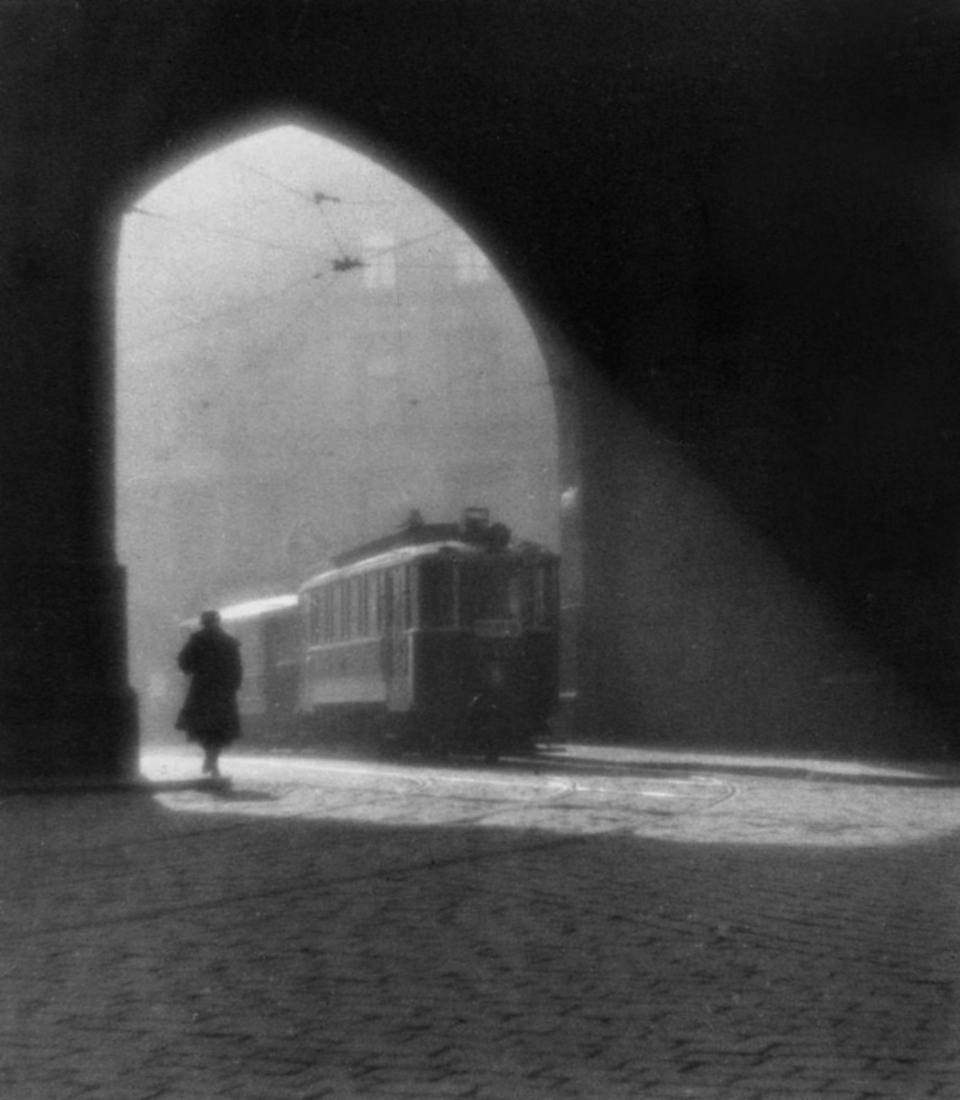
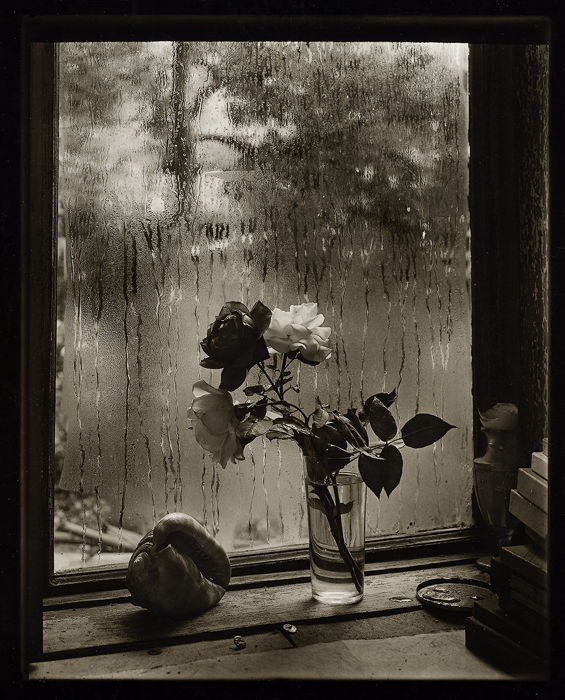
Josef Sudek photography
I came across her, the Weeping Woman of Prague’s streets, the same way people always come across their most treasured surprises – almost by accident, finding her alone and abandoned whispering softly on a dusty shelf of an antiquarian bookshop. From the way she carries herself, with an aura of furtive seriousness piercing the heart, one would say the place where I found her waiting for me becomes her like her tattered robe and averted face, for she is the very embodiment of all the pain of the human heart scattered across the obscure corners of history. She carries inside her voices that never sang loud enough to be remembered, to be offered the tender gift of compassionate memory; she silently sheds the tears of the living and the dead alike, the departed and the left behind, the abandoned and the forsaken.
Cette femme à la marche disgracieuse, à la carrure monumentale, n’était pas de chair et de sang – mais de larmes, rien que larmes. Elle n’était pas née d’une femme, mais de la douleur de tous et de toutes. […] Fixer droit au visage cette pleurante serait ténèbres pour le cœur, à jamais. Comment, en effet, contempler l’absolue nudité des douleurs humaines sans mourir à soi-même ?
Sylvie Germain – La Pleurante des rues de Prague
My first rencontre with the acclaimed French writer Sylvie Germain happened just at the same place where her Weeping Woman was born – in the streets of Prague. I followed the claudicatory gait of this giant knitted from sorrows and grief, and was transported on the delicate breath of the author’s beauteously lyrical prose from abandoned houses to shadowy alleys, cemeteries and the river, all so familiar to my sight and yet completely foreign, the city suddenly transforming anew under my eyes in a fluid movement like the rich embroidery of the changing seasons.
Josef Sudek photography
This fragile piece of writing, no more than a breath indeed, read like a fluent stream of poetic meditation contemplating the never healing wounds of loss, injustice, heartbreak and death. Imbued with melancholy, nostalgia and sadness, the author’s soothing voice is touching in subtle innuendos the bleeding spots of the most terrifying failures of humanity – the sufferings of the Jews in Europe, but also those sensitive scars that once tarnished the delicate tissue of hearts belonging to all those children whose life extinguished like a rosebud before full bloom, the hearts of betrayed and abandoned lovers, mothers and fathers crouching underneath the lonely heaviness of their vast sorrow. Le bouton de rose en train d’éclore. La beauté de la terre et de la floraison ; la beauté refusée.
On tremble, on est si nu, on a si froid. On supplie l’autre de venir vêtir notre nudité de son corps. On est si nu, que l’on est écorché, à moitié dépeaussé. On est nu jusqu’au cœur. Et l’on se sent petit, infiniment, et laid, tout ratatiné de chagrin et de froid, indésirable, à soi-même, à tous, de n’être plus désiré par l’autre. L’autre qui ne jamais reviendra.
Sylvie Germain – La Pleurante des rues de Prague
Twelve almost mystical apparitions of this silent fugitive who comes and goes without a trace, crossing the boundaries of time and space with unwieldy grace, always preceded by a strange inkling of agitation vibrating in the air. Twelve apparitions soak the streets of Prague with the tears and echoes coming from within the Weeping Woman’s invisible chest as she is bringing back to the surface of memory the forgotten and the lost. And so I followed her steps quietly in the slanting sunrays and the limpid air of autumn, while wondering
 Est-ce la chose
 Qu’on appelle une vie ?

 Un battement infime
 D’un cœur agité
 La douleur frémissante
 Dans les traces
 D’un amour perdu
À la moitié du chemin de la vraie vie, nous étions environnés d’une sombre mélancolie, qu’ont exprimée tant de mots railleurs et tristes, dans le café de la jeunesse perdue.
Guy Debord
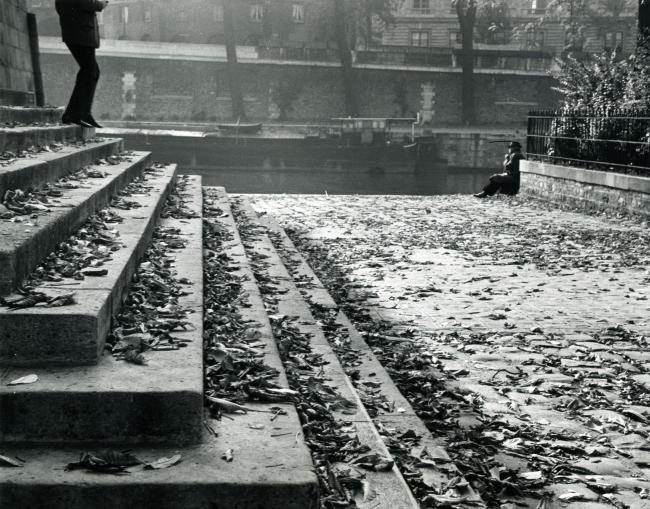
André Kertész photography
The air was cold and the stone sombre as my eyes thirstily stripped the city naked in the fresh autumnal wind. It swayed the branches above my head in soft whisper and brought with it the damp scent of October. Infused with proverbial melancholy, autumn becomes Paris like a finely tailored muslin chemise to Madame Récamier smiling shyly from François Gérard’s tender portrait.
Drunk on the atmosphere of the Capital of the World and the generous smiles of dashing French gentlemen, the archetypes of elegance à la française, I wandered through the streets like a sleepwalker in that October 2016, from Frédéric Chopin’s grave at Cimetière Père Lachaise to Île de la Cité, Place de Dauphine and the statue of King Henry IV., passing endearing little cafés whose lights winked mischievously at me with their warm glow, promising an atmosphere of incredible intimacy as the day became subdued by the outstretched arms of shadows. I wondered what strange fluidum it is that runs through the throbbing vessels of the city’s flesh, emanating such strong magnetism that chance encounters become lovers writing history and simple ideas immortal works of art.
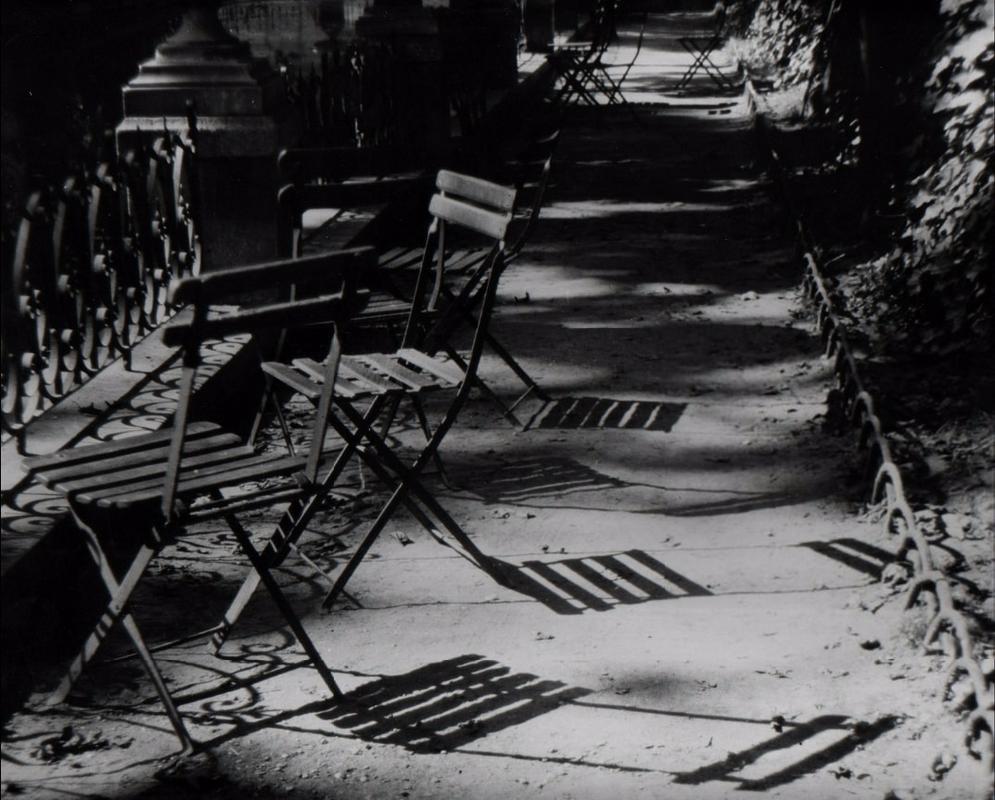
André Kertész photography
Paris is a city to get lost in, undoubtedly. Like an old antiquarian bookshop, it is an elaborate edifice of untold stories, names, names and names imprinted in the stucco of the buildings, the cracks in the pavement, the cobbles in the streets. There is always a ghost running at your heels that evaporates in the evening mist behind the next corner, and chasing them feels exhilarating.
Pour moi, l’automne n’a jamais été une saison triste. Les feuilles mortes et les jours de plus en plus courts ne m’ont jamais évoqué la fin de quelque chose mais plutôt une attente d’avenir.
Patrick Modiano – Dans le café de la jeunesse perdue
Tasting the autumnal Paris through the refracted glass of Modiano’s
multiple narrators, the reader slowly retraces the gently vibrating strings of
a youth enveloped in haunting sadness, like a quivering harp carrying a deeply
sorrowful melody. A student without a name, a detective, an abandoned husband,
a lover. All of them slowly spin a delicate thread, build a picture of a woman
whose face and voice blend with the city’s veins, a woman whose only legacy is
a history of her presence at Café du Condé, the centre stage of evening encounters shrouded in
half-truths, nicknames and mystery. Who is Louki, this woman who runs with the
shadows of Paris, changes logements as though she were hunted and sits in the
distant corner of the café, habitually coming in through the narrower and darker of the two
entrances? And why is her voice so so piercing, almost like a plea for rescue
from the shattered ruins of her past?
In the little novel, past becomes a narrator of its own, retelling a story
of loss and visceral loneliness pervading the very core of the heroine,
loneliness that sets her mercilessly apart from her surroundings, stemming from
wounds she found hard to face, or perhaps even name. They became phantoms
relentlessly pursuing her in her exhaustive need to flee – flee everything and
everyone, but mostly flee herself in a misguided attempt at liberation from the
chains that were binding her.
Plus tard, j’ai ressenti la même ivresse chaque fois que je coupais les ponts avec quelqu’un. Je n’étais vraiment moi-même qu’à l’instant que je m’enfuyais. Mes seuls bons souvenirs sont des souvenirs de fuite ou de fugue.
Patrick Modiano – Dans le café de la jeunesse perdue
André Kertész photography
As she too becomes a phantom to pursue those who once loved her, Modiano’s poignant prose takes the reader on a sombre tour through Paris’s night streets, abandoned cafés, memories slumbering in the dim lights of the street lamps, each one a shadow curled up in the hearts of those who loved and lost.
Encore aujourd’hui, il m’arrive d’entendre, le soir, une voix qui m’appelle par mon prénom, dans la rue. Une voix rauque. Elle traîne un peu sur les syllabes et je la reconnais tout de suit : la voix de Louki. Je me retourne, mais il n’y a personne. Pas seulement le soir, mais au creux de ces après-midi d’été où vous ne savez plus très bien en quelle année vous êtes. Tout va recommencer comme avant. Les mêmes jours, les mêmes nuits, les mêmes lieux, les mêmes rencontres. L’Éternel retour.
À partir de cet instant-là, il y a eu une absence dans ma vie, un blanc, qui ne me causait pas simplement une sensation de vide, mais que je ne pouvais pas soutenir du regard. Tout ce blanc m’éblouissait d’une lumière vive, irradiante. Et cela sera comme ça, jusqu’à la fin.
Patrick Modiano – Dans le café de la jeunesse perdue
People pass through the landscape of our hearts, always leaving a trace, a shadow upon their departure – a shadow whose contours are accentuated in due proportion by the intensity of our love’s light. And we are left wondering, waiting for the l’éternel retour that never comes, staggering through the abandoned streets of a city submerged in night, chasing ghosts that always evaporate behind the corner of the next street.
What are you whispering? Sorrow, sorrow. Joy, joy. Woven together, like reeds in moonlight. Woven together, inextricably commingled, bound in pain and strewn in sorrow—crash!
Virginia Woolf – The String Quartet
Like a flow of tender ripples, the words come rushing forward with a sparkling foam on their crests, seeping through the paper in merry chant of playful, Mozartean lightness as Virginia Woolf’s stream of consciousness unfolds in a crowded room filled with expectation-charged silence where four figures in fancy suits simultaneously lift the bows in elegant, sweeping arch, ready to touch the tense strings impatiently bursting with the wealth of unheard melodies.
The narrator’s thoughts pace back and forth between scattered exchanges whispered in the mild shadows of the dimly-lighted concert room and a wild torrent of vivid imagery, a flame ignited by the essential spark of music. Woolf’s narrative is music itself, her voice is a bow held in the deft fingers of a virtuoso violinist whose crystalline tone is brimming with passion, subtle twists leading into unexpected, soaring altered chords in what seems to be a perfectly non-defined, structure-defying symphonic poem.
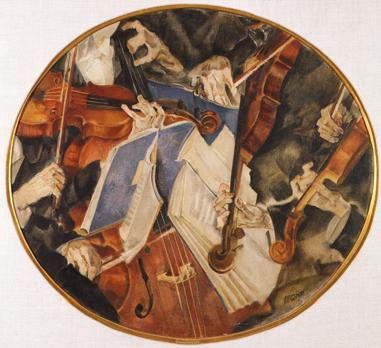
Max Oppenheimer – String Quartet
A miniature of fleeting perceptions and ephemeral feelings, though little revealing about music itself, The String Quartet is thought to be one of Virginia Woolf’s most acclaimed short stories. Just follow the path of music, the path of her words, grasping the silky threads of little nuances here and there, arriving to places never known before. Rushing from one scale into another in a stream of consciousness, the breath of her melody leaves you bedazzled and stupefied, like two musicians recovering from the heat of improvisation, looking at each other in profound amazement when the last pearly notes of their instruments dissolve in gentle diminuendo and blend into the welcoming embrace of silence, not realizing how they got from one key to another.
The boat sinks. Rising, the figures ascend, but now leaf thin, tapering to a dusky wraith, which, fiery tipped, draws its twofold passion from my heart. For me it sings, unseals my sorrow, thaws compassion, floods with love the sunless world, nor, ceasing, abates its tenderness but deftly, subtly, weaves in and out until in this pattern, this consummation, the cleft ones unify; soar, sob, sink to rest, sorrow and joy.
When entrapped in the sinister province of human mind, Dostoyevsky’s sovereign work field, multiple questions are bound to arise during and after the process of probing this dark abyss full of dangerous passions suppressed and unleashed, agonies of spiritual and physical suffering, shadows of madness looming large over sparse neurons of sanity. With bated breath one stands aside and watches as one is helplessly pulled into this terrifying roller-coaster ride only to finish spitted out exhausted in feeling and rational thinking onto the shores of empty confusion. The Karamazov Brothers is a philosophical walk through fire, a test of courage and personal convictions, a meeting with all the forces of Heaven and Hell clashing together in stormy encounter, the furious rattling of the steely kisses of enemy swords ringing in one’s head as the mad swirl of drums preceding a criminal’s execution.
One human. Thousand faces. Thousands of passions. Thousands of conflicts.
Family, honour, passion, piety, religion, atheism, politics, justice, crime, guilt, violence, suffering, mysticism. The bricks that make this philosophical monument a lasting prophesy of a genius mind, standing strictly opposed to each other, yet firmly entwined in what seems to be a kaleidoscope of a dark complexity. Moral, social, political, psychological and spiritual crises are blended in various shades of grey in between the sharp contrast of black and white, good versus evil.
Standing as the final accomplishment among the masterworks of the great Russian triumvirate, Tolstoy, Turgenev and Dostoyevsky, The Karamazov Brothers presents an extremely fertile field for exploring human nature, and consequently also the world as a reflection of the innermost, intimate working of human mind. For what else is world, if not a reflection of who we are?
Body,
mind and spirit – three brothers divided by elements of fundamental difference,
brought together by bloodshed, united by a sense of guilt. Dimitri, the
representation of passionate sensualism, Ivan, the embodiment of ever-sceptic
intellectualism, and Alyosha, the innocence of firm spiritual devotion. And
lastly Smerdyakov, the offspring of malice, cunning and contempt.
Rather than elaborating on the nature of each of the leading figures in this dramatic epopee, I cannot but declare how in awe I was of the dexterity with which Dostoyevsky works with these pulsating fibres of human intricacy, interweaving and pulling them apart on the precipices of their irreconcilable differences. Intriguing and complicated set of minds is presented to the reader as the brothers’ natural impulses come to inevitable conflict, starting with Dimitri’s irrepressible urge to kill because of jealousy fuelled by a passionate love for a woman, continuing with Ivan’s staunch undermining of God and religion by presenting a profound discourse on injustice and suffering, finished by Alyosha’s pious and peaceful, gentle love for God and humanity.
One could easily take the three brothers as a united model of the inner construction of human nature in general. In each human being, there are the germs of the Karamazov attributes scattered in different proportions, their prevalence depending on the inclination, maturity and life experience of the individual.
Moving from character traits and inner impulses to a higher dimension, the eternal struggle of faith with reason unfolds on the backdrop of a highly dysfunctional family, for me by far the most complex and intriguing of the palette of struggles presented by Dostoyevsky, culminating in Ivan’s descent into madness. The Grand Inquisitor, standing in grim contrast to Father Zosima’s exhortations, was a reflection of the fundamental questions every spiritually-minded person will pose to themselves over again during their lives – if there is God, and God is eternal love, why is there suffering on earth? Is free will truly a gift, or a curse to the human race? Is it not better for us helpless mortals to be led and shown the right way, instead of being generously given the opportunity to inflict deep wounds on each other? Shall one take as a sin solely the transformation of thoughts into actions, or the thought itself already? Is there an eternal life, a reality beyond the grasp of our mind with which we are tightly bound by the inherent, ceaseless longing for something transcendental?
On earth we are as it were astray. Much on the earth is hidden from us, but to make up for that we have been given a mysterious hidden longing for our living bond with the other world, and the roots of our thoughts and feelings are not here but in other worlds. That is why the philosophers say that we cannot apprehend the reality of things on earth.
Fyodor Dostoyevsky – The Karamazov Brothers
Part of the answer to Dostoyevsky’s crucial questions of spiritual doubting can be found in Ivan’s precarious conviction that everything is lawful, which ultimately leads to a turning point in the story, causing a stormy downward spiral to hell. Everything is lawful – a clue to the author’s prophesy about a world without faith, God and morality which stands merely on the tottering pillars of atheism, socialism and materialism.
What
made an everlasting impression on my mind from this impassioned philosophical monument
was the scene of the Devil visiting Ivan in his nightmare. From all chapters,
this one I found the cornerstone, the key to Dostoyevsky’s philosophy.
Le diable n’existe point.
The mirroring sentence to everything is lawful is a clue to the tragedy of the essential crime of The Karamazov Brothers, just as it is, in my mind, a clue to the tragedy of the evil committed in the world in such wild abundance. If one does not believe in evil itself, what can condemn crime and criminality as amoral? If one does not believe in moral laws, what else is there to prevent one from causing harm, pain and injustice?
The Karamazov Brothers is a metaphysical argument embedded in a world of ruthless sensuality that poses questions vital to the survival of human morality by shedding different light on progressing secularity that is increasingly set on eclipsing the existence of a higher, spiritual dimension of human race; questions valid for this age because of the polemics of human mind they encompass, creating an ever-repeating struggle of the variability of our essence.
The greatest treasures in life come layered in subtlety – beauty and wisdom hidden beneath the folds; understanding subtlety, however, takes time and patience, and a heart smooth and malleable like wax.
In choosing the opening quote by Polish writer of Jewish origin, whom I had had the honour to encounter on a half-forgotten shelf of a small antiquarian bookshop in the forlorn lanes of Prague, I came to realize that this soft, poetic sigh bears a large significance, for it represents the ultimate achievement one can possibly strive for – a heart that revels in the mysteries of life, accepting all their intricate subtleties.
And,
unfortunately, it may seem the world has long forgotten the imperceptible art
of subtlety.
As someone who bears the unique privilege and the heavy responsibility to see life from both sides, to witness the miracle of a life being born and the grief of a life flickering out, I decided to lay down the records of exalted joys and private mourning, for there is a long path to be trodden connecting them both – a path nothing short of interesting for its richness of discovery and perception.
And so in setting up this small creative corner, I will focus on that vast landscape lying in between which, detail after detail, laboriously builds our inner and outer reality.

 L'art de subtilité